
READ ALL ABOUT IT
CHECK OUT OUR BLOG FOR CHICAGOLAND & SOUTHERN WISCONSIN
Lake Zurich Mosquito Control for Lake-Adjacent and Marsh-Adjacent Yards
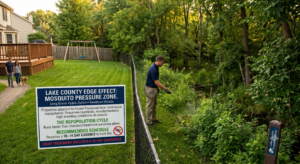
Properties directly adjacent to Lake County forest preserves experience a heavy “edge effect,” where mosquitoes continuously migrate from natural wetlands and woods into managed backyards.
If your yard in Lake Zurich sits near the lake or the nearby Cuba Marsh system, your mosquito situation isn’t the same as a yard three blocks from the water. The standing water, shoreline vegetation, and nearby marsh habitat create conditions that keep mosquito pressure higher and extend the active season further into the fall than inland properties in the same suburb typically see.
Treatment plans for these properties work better when they’re built around what the water habitat actually does, rather than a standard, suburb-wide cadence applied uniformly across Lake Zurich lots.
Why Water-Adjacent Yards Face Heavier Pressure
Mosquitoes need standing water to complete their life cycle, and they don’t need much of it. The lake itself circulates enough that open water isn’t the primary issue. The problem is the edges: shallow shoreline depressions, marsh pockets, and vegetation-lined inlets where water sits still long enough for eggs to hatch and larvae to develop.
Cuba Marsh, the wetland system near the lake, adds a meaningful layer to this. Wetland habitat combines shallow water with the organic material that larvae feed on. Adult mosquitoes can travel well beyond where they breed, reaching properties that have no standing water on the lot itself. That means a yard near the marsh can receive consistent adult pressure from populations that bred entirely off the property.
Inland yards deal with temporary sources: a clogged gutter after a rain, a plant saucer that didn’t get emptied. Those sources dry out. Lake Zurich and the Cuba Marsh system don’t. That continuity keeps repopulation faster between treatments. It also makes the lake-adjacent season run longer into fall than it does for properties further from the water.
What the Village of Lake Zurich’s Abatement Program Covers
The Village of Lake Zurich runs a mosquito abatement program built around larval control. Each season, the Village maps and inspects well over a hundred potential breeding sites (retention ponds, drainage ditches, wetlands, and low-lying areas that hold water) and applies larvicide at those sites and at the street-side catch basins to reduce both nuisance mosquito populations and the risk of West Nile virus. The work happens at the breeding sites across the Village, not on individual private lots.
That distinction matters. The program targets breeding sites of mosquitoes in public, accessible areas, and reduces overall pressure. Treating the resting vegetation on a private residential property on a property-specific schedule falls outside its scope.
This means lake-adjacent homeowners in Lake Zurich are managing the population that reaches their yards from nearby water bodies. The Village program reduces breeding across the area around you. Your yard is a separate question.
Treatment Cadence for Lake-Adjacent Properties
For most yards in the Lake Zurich area, treatment intervals can stretch toward the longer end of the range. Lake-adjacent and marsh-adjacent properties work differently because proximity to breeding habitat means adult populations restock more quickly than they do on inland lots. For these properties, we treat on a 10–14-day schedule rather than the wider 10–21-day window that applies to open lots.
The 10-day guarantee we stand behind on every treatment is relevant here in a specific way. If mosquitoes return before that window closes, we come back at no charge. On a lake-adjacent property, the 10–14 day cadence keeps us ahead of restocking rather than reacting after the fact.
Treatment focuses on the vegetation where adult mosquitoes shelter during daylight hours: the undersides of leaves, shrubs, mulch beds, and dense plantings. That’s where populations rest between feeding periods. Application near the water’s edge follows state and local guidelines for aquatic-adjacent environments.
Tick Pressure on Lake-Adjacent and Marsh-Adjacent Yards
Properties near water and marsh habitat in Lake Zurich also see elevated tick activity. Grassy shoreline areas, leaf litter near the water’s edge, and the low transitional vegetation between marsh and maintained lawn are typical tick habitats, where ticks wait at the tips of grass and brush for a host to pass through.
Skeeter Beater’s treatments address both mosquitoes and ticks. The barrier application targeting harborage vegetation covers both pest populations. The treatment timing aligns with both mosquito season and the peak tick activity window in Lake County.
Seasonal Timing for Lake-Adjacent Properties
Treatment season starts when overnight temperatures consistently remain above 50°F, which in most years occurs from mid-April to early May. For lake-adjacent and marsh-adjacent yards, the active season extends further into fall. The lake and the marsh system remain viable as breeding environments through temperature swings that would shut down activity in a clogged gutter or a plant saucer. They don’t dry out the way temporary sources do.
Meaningful mosquito pressure on lake-adjacent properties in this area can persist into October. During warm autumns, which can extend into early November, while inland yards have largely quieted by then. Planning treatment coverage through that extended window is part of what makes a lake-adjacent program different from a standard schedule.
Skeeter Beater has worked with over 1,000 families across Lake County and the North Shore since 2003. If your property in Lake Zurich sits near the lake or the marsh system and you’re trying to figure out what a realistic treatment schedule looks like, we’re in the area and worth a conversation.
FAQs
What makes mosquito control more challenging for properties near lakes and marshes?
Lake-adjacent and marsh-adjacent yards sit next to a standing-water habitat that doesn’t dry out between rain events, unlike temporary sources. Shallow shoreline areas, marsh pockets, and vegetation-lined inlets provide consistent breeding conditions throughout the season. Adult mosquitoes from nearby wetlands can reach properties without standing water on the lot itself.
That means population pressure doesn’t depend only on what’s happening in your own yard. Treatment intervals for these properties run shorter (typically 10–14 days) to stay ahead of how quickly populations restock from external sources.
Does the Village of Lake Zurich treat private waterfront properties for mosquitoes?
No. The Village’s program is built around larval control: it maps and treats breeding sites across the Village (retention ponds, drainage ditches, wetlands, low-lying areas, and street catch basins) to reduce nuisance populations and the risk of West Nile virus. It treats where mosquitoes breed in public and accessible areas, not the resting vegetation on a private lot. Homeowners with lake-adjacent or marsh-adjacent yards need to arrange their own property treatment.
How do barrier treatments work for yards near water?
Barrier treatments target the vegetation where adult mosquitoes shelter between feeding periods. Treatment concentrates on shrubs, mulch beds, dense plantings, and foliar surfaces in landscaped areas. Near the water’s edge, the application remains within landscaped and vegetated areas and adheres to state and local guidelines for aquatic-adjacent environments. Skeeter Beater sees roughly 90% mosquito knockdown after treatment, backed by a 10-day guarantee. If mosquitoes return inside that window, we re-treat at no charge.
When does mosquito season start and end for lake-adjacent properties in Lake Zurich?
The season generally begins when overnight temperatures hold above 50°F, typically mid-April to early May in the Chicago area. For lake-adjacent properties, the active period extends further into fall. The lake and marsh habitats remain viable breeding environments because temperature fluctuations would shut down activity in smaller, temporary bodies of water. Meaningful pressure on these properties can persist into October and into early November during warm autumns.
Do natural predators help control mosquito populations near water?
Dragonflies, bats, and various birds feed on adult mosquitoes. Natural predation is real and can reduce pressure somewhat at the margins. For properties sitting beside established lake and marsh habitats, though, the population volumes those environments produce are substantial enough that predation alone doesn’t offset the breeding capacity nearby. A consistent barrier treatment schedule is what keeps pressure manageable on a lake-adjacent property through the full season.
