
READ ALL ABOUT IT
CHECK OUT OUR BLOG FOR CHICAGOLAND & SOUTHERN WISCONSIN
Mosquito and Tick Treatments: How They Work and When They Make Sense
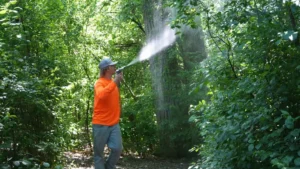 Mosquito and tick treatments are distinct applications, with different target zones, pest behavior, and points of contact on your property. Whether combining them into a single service program makes sense depends on whether your yard’s layout gives both pests somewhere to establish. For some properties, the combination is the right call. For others, one service line covers what’s actually present.
How Mosquito Barrier Treatment Works
Adult mosquitoes spend most daylight hours resting in shaded vegetation rather than flying. According to Illinois Extension, harborage areas (dense shrubs, ornamental plantings, shaded fence-line understory, and the spaces beneath decks) are where resting populations concentrate between activity periods. Those resting sites are the target.
Barrier treatment applies an organic spray to perimeter vegetation and harborage zones. Mosquitoes move through treated vegetation and encounter the product before reaching open areas where people spend time. The application concentrates on foundation beds, wooded borders, and any dense-canopy areas that provide daytime cover.
Re-entry after treatment is safe for family, kids, and pets approximately one hour after application, or once the treatment has visibly dried on surfaces, whichever comes first. If you have cats, apply that window more conservatively.
How Tick Treatment Works
Ticks are ground-level and low-canopy pests. Illinois Extension describes tick questing as a passive behavior: ticks position themselves on low vegetation, grass blades, and leaf litter in shaded, humid areas and wait for a host to brush past.
Tick treatment targets those ground-level zones: the base of shrubs, stone wall perimeters, wood piles, brush lines, and leaf-litter accumulation points. According to Illinois Extension, transition zones (the edges where maintained lawns meet wooded areas, brush, or unmowed margins) tend to have the highest tick pressure in residential yards. That edge strip is where treatment focuses.
For households where kids and dogs spend regular time outdoors, tick-borne illness is worth factoring in alongside mosquito nuisance. Illinois carries documented risk for Lyme-carrying deer ticks. That context matters when deciding whether tick treatment belongs in a service plan alongside mosquito control.
What Combined Treatment Looks Like on a Single Visit
A combined treatment visit handles both applications in sequence during one property call. The mosquito barrier application covers perimeter vegetation and harborage zones. The tick application follows, targeting ground-level edge zones, transition areas, and low-canopy cover where tick populations concentrate.
The two applications address different vertical zones. A mosquito barrier application covers mid-canopy and perimeter vegetation. A tick application remains at ground level, focused on the transition strip and brush edges. Combining them in a single scheduled visit means both zones get addressed without requiring two separate service windows.
Skeeter Beater’s 10-day guarantee applies to both portions of a combined visit. If mosquito or tick activity returns within 10 days of treatment, we re-treat at no charge.
Which Yards Genuinely Benefit from Mosquito and Tick Treatments
Combined treatment is the right call when both pest pressure profiles are present on the same property. Properties with wooded edges, brush lines, or grass-to-natural-area transitions carry meaningful tick pressure alongside mosquito pressure. Forest-preserve-adjacent yards in Lake County and along the North Shore often have that combination. Long Grove, Lake Zurich, and Hawthorn Woods are typical examples of properties where both services are warranted.
For households with kids and dogs spending extended time outdoors, both concerns have real stakes. Mosquito nuisance increases with outdoor exposure time. So does tick-borne illness risk. Those two considerations are worth addressing together when the property’s layout makes both real.
Open lots with full sun, minimal wooded edges, and no significant brush or woodland transitions typically carry lower tick pressure. Mosquito-only service may be sufficient for those properties. The relevant question is whether your yard’s layout actually gives both pests a suitable habitat.
What to Expect with Mosquito and Tick Treatments: Cadence, Guarantee, and Seasonal Arc
Mosquito and tick treatments in the northern and northwestern Chicago suburbs typically open between mid-April and early May, continue through October, and extend into November during warm autumns. The relevant threshold is nights consistently above 50°F, at which both mosquito and tick activity become significant enough to treat.
Treatment frequency varies by yard type. Forest-preserve-adjacent yards and wooded subdivisions generally call for 10 to 14 days between treatments. Constant pressure from the surrounding habitat keeps pest populations from restocking between applications. Open lots with less surrounding habitat pressure can run 10 to 21 days between visits.
We see roughly 90% mosquito knockdown after a treatment, backed by the 10-day guarantee. If populations rebound within that window, the re-treatment is on us.
Before settling on a service plan, it’s worth considering which pressure profiles your yard actually carries. If your property has wooded edges, brush transitions, and proximity to natural areas that support pest populations, combined treatment gives you coordinated coverage across these areas in a single scheduled visit.
Skeeter Beater has worked with over 1,000 families across Lake County and the North Shore since 2003. If you’re in the north or northwest suburbs and want to talk through what your yard’s layout calls for, you can reach us at (888) 587-5338.
FAQs
How does mosquito barrier treatment differ from tick treatment on the same property?
Mosquito treatment targets mid-canopy and perimeter vegetation where adult mosquitoes rest during the day: fence lines, shrub borders, ornamental plantings, and spaces beneath decks. Tick treatment remains at ground level, focusing on the transition zone where maintained lawn meets wooded edges, brush, or stone walls. The two applications address different vertical zones of the yard, so a combined visit handles them in sequence rather than a single application covering both pests.
Does every yard in Chicagoland need combined mosquito and tick service?
Properties with wooded edges, brush lines, or grass-to-natural-area transitions carry both pressure profiles and are the strongest candidates for combined service. Open lots with full sun and minimal wooded borders often carry lower tick pressure, and mosquito-only treatment may be sufficient. Your yard’s layout tends to determine which service line is appropriate. A property with no significant brush or woodland edge gives ticks limited habitat to work with.
What is the 10-day guarantee on combined treatment?
The 10-day guarantee covers both the mosquito and tick portions of a combined visit. If pest activity returns within 10 days of treatment, Skeeter Beater returns for a re-treatment at no charge. The guarantee applies to every treatment.
When does mosquito and tick treatment season start in the Chicago suburbs?
The typical start window is mid-April through early May, depending on temperature. The relevant threshold is nights consistently above 50°F. Treatment continues through October and often into November during warm autumns. Starting before mosquito populations spike in late spring means working ahead of the first population surge. Adult mosquitoes overwinter in protected spots and become active with the first sustained warm stretch.
Is combined treatment safe for kids, pets, and plants?
Treatments are safe for kids, family members, pets, and plants. Re-entry is appropriate approximately one hour after treatment or once the application has visibly dried on treated surfaces, whichever comes first. If you have cats, apply that re-entry window more conservatively, and if a pet shows any signs of distress after re-entry, consult a veterinarian.
